
Your AI Pilot Didn’t Fail. It Starved.
- By Winston Thomas
- September 06, 2026

The math is obvious when it comes to why AI PoCs wait at the production gateway as science experiments. SCBX calls it pilot purgatory, and rightly so.
Thai companies are not shy of being experimental. Deloitte’s Thailand Digital Transformation Survey puts 61% of businesses attempting to implement AI, but only 19% have successfully scaled AI across the enterprise. That means 81% remain in the pilot or experimentation stage. Yet, Omdia’s “Staying Ahead in the AI Era report, released with Informa in May 2026, expects 42% of surveyed Asia-Pacific companies to spend at least USD1 million each on AI agents this year.
But the numbers do not tell you the whole story. You may conclude Thailand needs more time, more talent and more budget. But when two dozen data and technology leaders from banking, insurance, petrochemicals, automotive, retail, telco, logistics and a university gathered on July 22 at an executive roundtable titled “Escaping the Sandbox: Accelerating the Move from AI Pilots to True Enterprise Autonomy,” they all pointed to the same problem: live data that is governed at production volume.
Pilots consume data that does not reflect actual production
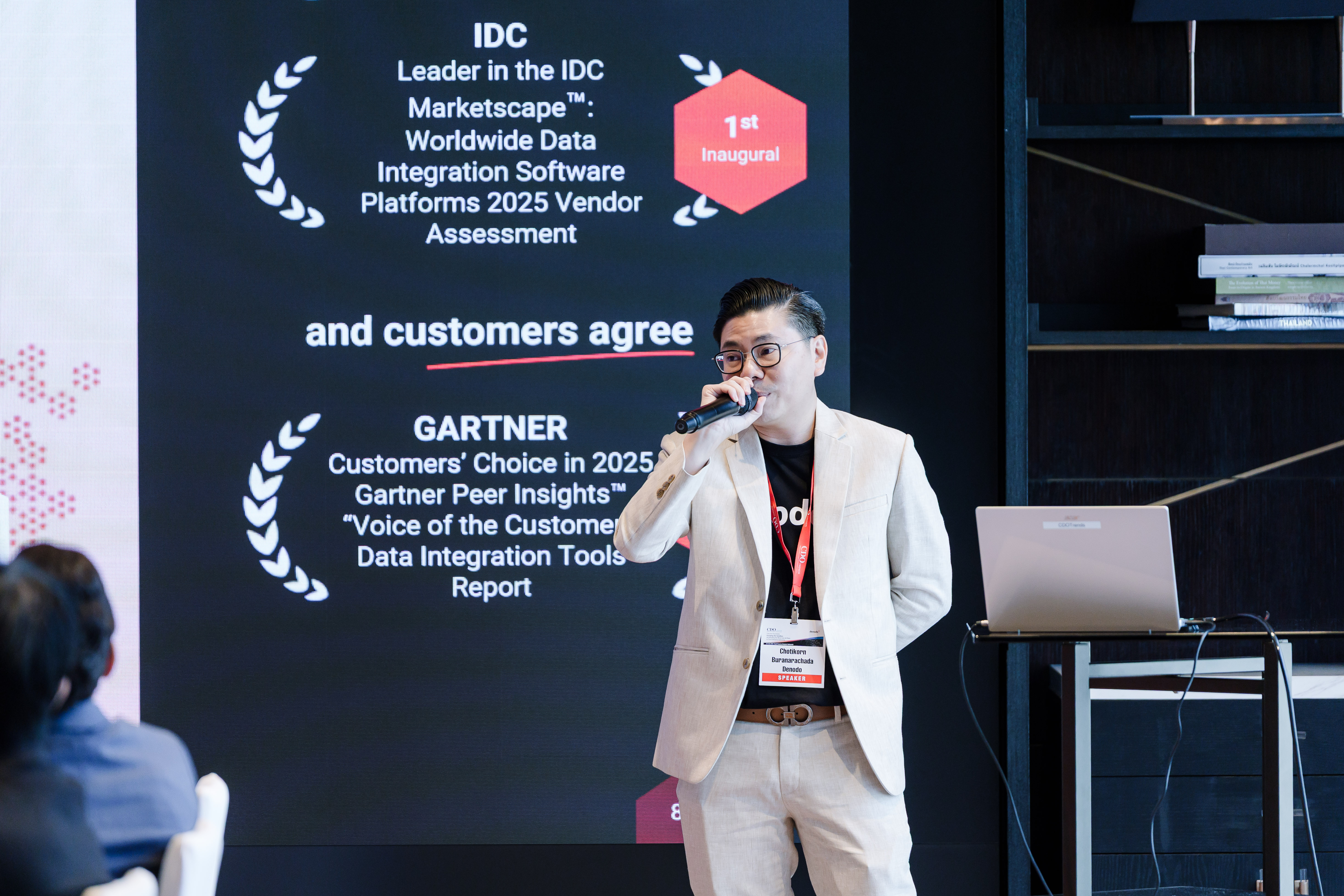
Chotikorn Buranarachada, Denodo’s country sales director for Thailand, gave three reasons pilots stall. Data is often scattered across dozens of enterprise systems, including ERP, CRM, operations, and IoT, which makes it difficult for AI to find and use the right data. Governance is too thin for anyone to trust the output. Then the third, which is the one worth really arguing about.
“Most of the time we are using static data,” Buranarachada said. “We have well-prepared data to do the pilot project. But in reality, when we are moving from the pilot to the production, it needs a lot more data. It also needs a lot more governance.”
It’s the failure mode in one sentence. A successful pilot is often evidence of the failure coming. Somebody hand-assembled the extract that made the demo work, and nobody can assemble it again next Tuesday at 9 a.m., for 40,000 customers, with lineage a regulator would accept. The pilot only proved that a data engineer worked a weekend.
The room supplied the evidence. A transformation lead at a Japanese automaker spent three years building a data platform before touching AI and still cannot get data into a semantic form an agent understands. A petrochemical group grown by acquisition inherited a museum of ERP systems. An insurer runs legacy systems with no usable metadata, so cleanup eats the calendar before modeling starts.
A retail executive named the belief that kills more projects than any technical fault: management assumes whoever holds the most data wins. But if that data has no dictionary and no agreed meaning, the volume buys nothing but storage cost. His second point cut deeper: leaving the sandbox means changing enterprise IT workflows, and most companies would rather buy a tool than change a process.
Guess what was mostly missing in this AI conversation: Model selection.
The reflex that makes it worse
Angel Viña, Denodo’s founder and chief executive officer, who left Spanish academia for California to build the company, highlighted why this data challenge will only get worse when the consumer of data stops being human. “Agents are big consumers of data,” he said. “They have a power that even humans cannot parallel. If you open the data box for them, they will eat everything in seconds, in milliseconds.”
Faced with that appetite, the instinct is to build a data warehouse. Viña pointed the room the other way: “The top recommendation in a Yale University Leadership CEO Summit I attended in June this year was don’t re-platform. Don’t say, okay, let’s get rid of all this data infrastructure and rebuild for AI, because you may face significant change in the next 12, 18, 24 months. Activate your data first.”

Data activation requires a few key capabilities instead of just blind migration. Unified connectivity, so an agent meets one front door instead of 40; governance applied at the agent level; semantics, which Viña treats as the hard one. “Because the customer may mean something very different in the supply chain than in finance, or in manufacturing, or in HR.”
Anyone who has sat through a definition war over the term ‘active customer’ knows it is no academic discourse. It is why two dashboards from two separate departments disagree, and why an agent will act confidently on the wrong one.
Denodo’s answer is zero copy. Instead of piping everything into one mega repository, it composes a data product from elements that stay where they are. “That also brings real-time capability, so important for agents,” Viña said. “Agents want the data of the moment.” Six days before this lunch, Denodo shipped a new release, built around that phrase: active context for agentic AI.
The half-life of your business case
The automaker’s lead then asked the question that vendor decks avoid. How do you stop the hidden costs of ETL, pipelines, and semantic layers from eating the business case?
Viña’s answer was structural. Copying data costs more than storage. Every copy has to be moved, refreshed, and computed against, and those bills keep arriving. Send the query to the data instead of moving the data to the query, and the copy never gets made. Then he made a commercial claim: “Our business model is data products consumed, not data products created.”
An executive from the systems integrator co-hosting the session supplied the anecdote that landed hardest. His firm helped a Thai client stand up an AI data center on a business case promising savings in six months. Before it was running, new hardware arrived and reset the economics. The client went back to the drawing board.
The case highlights the real risk in 2026. Any architecture that commits you to a physical destination bets the market holds still longer than your procurement cycle runs. Nvidia moved to annual architecture releases in 2024, and Ampere, Hopper, Blackwell and Rubin have arrived on that rhythm since. Thai tax rules let you write computer hardware off over three accounting periods. The hardware moves faster than the write-off.
Governance is a differentiator, not a wall
A telco leader said flatly that without a governance framework, nothing moves past pilots. An insurance product owner described the squeeze between a group mandate to put AI in every project and the obligations of a regulated subsidiary.
Cho’s reframe was logical: “We should utilize the PDPA as our competitive advantage, not try to avoid it,” he said. “If we can process the data within the compliance regulatory area, we can utilize that data fully, compared to the company that is not using this as a differentiator.”
In other words, if lineage, access control, and audit trails belong to the layer every agent queries through, compliance stops being a gate at the end and becomes a capability at the start. You use more data, not less. Viña cautions that the target keeps moving. “It’s not just data governance, it’s also AI governance. But everything is actually data.”
“AI is built on trust, especially trusted data,” Cho added. Treat the agent as a data consumer, one of your best analysts, and feed it accordingly.
What actually separates the 19%
Talent and budget are the answers boards expect, and they explain less than they appear to. Every organization in the room on July 22 had money and hired well. The variable that tracks with production is less glamorous: whether the pilot was ever built on something the business could keep supplying on a normal Tuesday, under real governance, at real volume.
The room kept circling four moves before the next budget cycle:
- Cost the alternative to migration. Before approving the next consolidation, price the option of querying data in place with governance in the layer. If nobody has run that comparison, the consolidation is a default, not a decision.
- Kill the static-data pilot. A proof of concept running on a hand-prepared extract has proven nothing about production. Rebuild it against live sources, or stop reporting it as progress.
- Give three contested terms a single source of truth. Customer, active, revenue, or whatever your definition wars are about. An agent will not reconcile them for you, and it will act anyway.
- Put readiness on the first slide. Readiness, timeline, cost, in the language the board already uses for credit risk and safety.
Every quarter adds another dead pilot to the list. The companies that stop adding to it will not be the ones with the best model. They will be the ones that did not starve the model of live, governed data.
Image credit: iStockphoto/charles taylor





Winston Thomas
Winston Thomas is the editor-in-chief of CDOTrends. He likes to piece together the weird and wondering tech puzzle for readers and identify groundbreaking business models led by tech while waiting for the singularity.